Cedar Rapids Epoxy FlooringPros
Broadcast chip floors · Cedar Rapids, IA

Flake Floor Epoxy: Choosing the Blend, Chip Size and Broadcast

A flake floor is three choices stacked on one slab: the color blend, the chip size and how heavily the chips are thrown. Those three decide what the floor hides in February, how it feels under a wet boot and how hard it is to mop. Work through them below before anyone talks price.

  • Blend chosen from physical chips, not a screen
  • Full broadcast to rejection, scraped and vacuumed
  • Topcoat picked for sun and salt

The speckled background is a drawing made with CSS, not a photo of a floor.

  • The chips carry the color They are vinyl flakes, not stone. The blend you pick is the color you live with, and a chip does nothing to protect the slab.
  • The base coat holds them A tinted epoxy coat goes down and the chips are thrown into it while it is wet. Its tint shows through the gaps and shifts the overall tone.
  • The topcoat takes the wear The clear coat over the chips is what salt, tires and the snowblower actually touch. It sets how the floor cleans and whether it yellows.

Flake is one finish on a full coating system; the grinding, moisture testing and repairs under it are the same as any epoxy floor coating job, and they matter more than the blend.

The build

How an Epoxy Flake System Is Built: Full vs Partial Broadcast

"Broadcast" is how many chips go into the wet base coat. It changes the look, the texture, the amount of material and the number of topcoats, so it is the first thing to settle.

Full broadcast, to rejection

Walt Tools, which sells flake kits, describes it plainly: "Keep broadcasting until the next chips you throw just sit on top of the previous layer (rejection)." The base disappears under chips. That gives the most texture and the most hiding power, and it is the build most garages get.

  • No base color shows, so the base tint matters little
  • Rougher underfoot and on knees, harder to mop
  • One clear topcoat in the kits we cite

Partial broadcast, base left showing

Here the thrower stops early. In Walt Tools’ words, "You stop broadcasting before rejection, leaving portions of the tinted base coat exposed as part of the design." It uses fewer chips, and the same guide says it needs two layers of topcoat to protect the exposed resin.

  • The base tint becomes half the look; pick it as carefully as the chips
  • Smoother, easier to mop, slicker when wet
  • The open base shows dirt like a solid-color floor

The two squares above are drawings of the difference, not photos.

Epoxy flake floor installation, in the order it happens

  1. Grind and repair. The slab is diamond ground, cracks and door-edge pitting are filled, and the moisture readings are in hand. Chips hide a lot, but they sit on whatever is under them.
  2. Roll the base coat in sections. Each section is sized so the crew can cover it with chips while the coat is still wet. A section that skins over before chips land holds them poorly.
  3. Throw the chips. The crew walks the wet coat in spiked shoes and throws chips up and out so they fall like snow, not straight down in clumps. Walt Tools notes that "larger throws distribute more evenly; smaller, tighter throws can create uneven density," which is what leaves thin patches in a rushed floor.
  4. Cure, scrape, vacuum. After the base cures, loose chips and the ones standing on edge are scraped off and the floor is vacuumed. Skip a pass and the topcoat locks the sharp edges in.
  5. Topcoat. A clear coat over the chips, two over a partial broadcast. A polyaspartic topcoat is the common pick where the door stays open to the sun, because it doesn’t amber the way plain epoxy can.
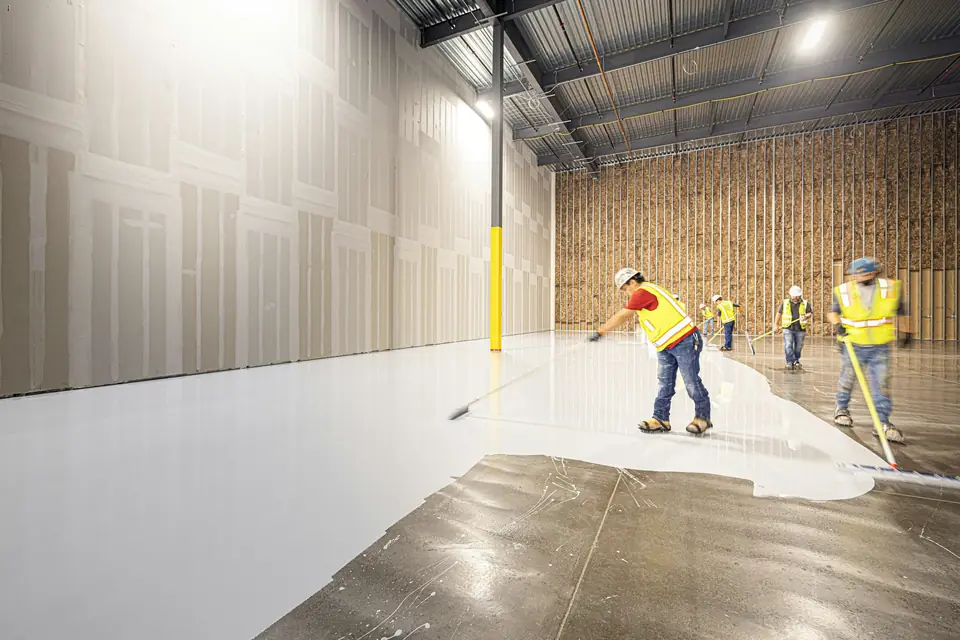
Crew in hi-vis vests spreading a white coating over bare concrete with long-handled squeegees and rollers
Stock photo of a crew spreading a base coat. On a flake floor, the chips go into a coat like this while it is still wet.

What the published rates mean for a 20-by-20-foot floor

LayerPublished rate (Walt Tools flake kits)For 400 sq ft (our arithmetic)
Base coat100 sq ft per gallon, or 150 over a primerAbout 4 gallons, or about 2.7 over a primer
1/4" chips, full broadcastAbout 8 sq ft per lb; 5 to 10 depending on chip size and techniqueAbout 50 lb, anywhere from 40 to 80 lb
Clear topcoat175 sq ft per gallon, per coatAbout 2.3 gallons per coat; double it for a partial broadcast

Why this is worth knowing: when a written estimate lists chip pounds and gallons per coat, you can check that a "full broadcast" really has enough chips in it. A bid that is light on chips by half is a partial broadcast with a full-broadcast name.

Sources: Walt Tools flake flooring guide (broadcast definitions, coverage rates, chip size, topcoat layers) · UV: Benjamin Moore HP4300 epoxy TDS, APF Polyaspartic 7500 PDS, Duraamen Perdure P90. We cite these makers to show typical numbers, not because we use a particular brand.

Color, size, density

Picking a Garage Flake Floor Blend You’ll Still Like in Ten Years

Most blend regret comes from one of two things: picking from a 2-inch sample that looks far busier across a whole floor, or picking a color that fights the dirt your garage actually gets. Try the combinations here, then go look at real chips.

Build a flake blend

An illustration drawn in your browser, not a photo or a color match. Real chips vary by maker and production lot and look different under garage lights. Choose from physical samples on your own floor.

1. The blend

  • Salt and pepper

    Mid gray, black and white chips over a gray base.

    Hides The widest mix of garage dirt: dried salt film, sand, dust and most tire scuffs all land on a chip close to their own color.

    Shows Not much. A fresh oil drip shows as a shiny spot until it is wiped up, as it does on any blend.

    Tradeoff From standing height it reads as plain speckled gray, which is the point for most garages and a letdown if you wanted color.

  • Earth

    Tan, brown and cream chips with a few dark brown flecks over a tan base.

    Hides Sawdust, dried mud, sand from the street and light-colored dog hair.

    Shows Black rubber from tires and the white crust road salt leaves behind, both more than a gray blend does.

    Tradeoff Warm next to wood shelving and a cedar-sided house; next to gray steel cabinets it can look like a mismatch.

  • Slate

    Blue-gray, light gray, white and black chips over a blue-gray base.

    Hides Salt film and fine dust well, because the white and light gray chips break it up.

    Shows Sawdust and tan sand sit on a cool background and stand out a little.

    Tradeoff The blue reads stronger under cool LED shop lights than it does on a 2-inch sample in daylight. Look at it under your own lights.

  • Garage red

    Black, red, gray and a little white over a dark gray base.

    Hides Tire marks and oil stains, thanks to the dark share of the blend.

    Shows White salt film and light dust on the black chips.

    Tradeoff The loudest of these. A team-color floor you love on a sample can feel like a lot across 400 square feet, and it is a taste the next owner may not share.

  • Domino (light)

    Mostly white with light gray and a sprinkle of black, over a light gray base.

    Hides Dried road-salt film, which is close to its own color, and it brightens a dim garage.

    Shows Tire marks, oil, dark dog hair and anything tracked in on a wet tire.

    Tradeoff Looks clean in a showroom and needs the most sweeping to stay that way in a salted garage.

  • Charcoal (dark)

    Charcoal, near-black and gray chips with a few white flecks, over a charcoal base.

    Hides Rubber, oil and grease, which is why dark blends show up in shops.

    Shows Exactly what winter brings: white salt film, tan sand, sawdust and light dog hair.

    Tradeoff A dark floor also makes a garage feel smaller and darker. In a Cedar Rapids winter it will look dusty white most mornings.
2. Chip size

  • 1/4 in chips

    The common size for a garage broadcast. Each chip reads on its own from standing height. Walt Tools builds its flake kits on 1/4" vinyl chips and notes they are "larger and lighter than quartz," which makes an even throw easier.

  • 1/8 in chips

    A tighter, more granite-like speckle. The blend reads closer to one overall tone from a few feet away. Torginol, a flake maker, lists its blends in 1/4" and 1/8".

  • 1/16 in chips

    Fine enough to read almost as a single color with texture. Torginol’s 1/16" flakes are sold through flooring distributors. Good for a basement or a small room where a big chip looks out of scale.

3. Broadcast density

  • Full broadcast

    Chips go into the wet base until it cannot take more. No base color shows. The most texture, the most chip material and the best at hiding dirt.

  • Partial (accent)

    Chips are scattered and the tinted base shows between them as part of the look. Smoother and easier to mop, but the open base shows dirt like a solid-color floor, and it needs a second topcoat.

4. How far away you are

  • Close up, like a sample

    Roughly what you see holding a sample chip pile or a small board.

  • Across the floor

    Closer to what you see from the door. Contrast adds up over a whole floor: low-contrast blends melt into one tone, high-contrast ones get busier.

Chip sizes: Walt Tools flake guide (1/4" vinyl chips) · Torginol (1/4" and 1/8" blends) · a distributor listing for 1/16" flakes. Blend names here are plain descriptions of chip colors, not product names.

Pick the blend for the mess you have

A garage that sees salt all winter wants white and gray in the blend. A shop corner with a leaky mower wants dark. The dirt test below lines them up.

Lower the chip contrast a notch

If two blends feel close on the sample, the calmer one usually wears better. Contrast multiplies across a floor, and a third of it ends up under cars anyway.

Match the base to the chips

On a full broadcast nobody sees the base. On a partial broadcast it is half the floor, so it should be the blend’s dominant chip color, not a contrast color.

If what you actually want is a floor that looks poured rather than speckled, a metallic pour is the other decorative route. It is glossier and more dramatic, and it hides far less of a Cedar Rapids winter than any blend on this page.

Texture

Flake Flooring Texture: Grip Underfoot vs Easy Mopping

Texture is a trade, not a feature. Every bit of grip under a wet boot is also a bit of surface that holds grit and drags on a mop. The chip edges under the topcoat are what you feel, and the finish choice decides how much of them comes through.

Here that trade is set by winter. The high temperature at the Cedar Rapids airport stays at or below freezing on about 55 days a year, so snow packs into wheel wells on the drive home and melts into slush on the garage floor. Add the grit from the city’s sand and salt mixes, and a floor that is easy to squeegee out the door is worth as much as one that grips.

The honest part: a full broadcast is rougher on knees than a smooth floor, and it is harder to mop. If you change oil lying on the floor or roll a creeper across it, that matters more than slush grip, and a second topcoat or a smaller chip is the better build.

Source: NOAA 1991–2020 normals, Cedar Rapids airport (55.2 days a year with a high at or below 32°F).

Compare the finish options

  • Full broadcast, one clear topcoat

    Grip on wet slush: good. Mopping and squeegeeing: harder.

    The standard garage build. Chip edges stay close to the surface, which gives a fine sandpaper feel. Grit settles into the texture, so a push broom works better than a string mop.

  • Full broadcast, two clear topcoats

    Grip on wet slush: fair. Mopping and squeegeeing: easier.

    The second coat fills the texture and buries the chips deeper. It feels smoother on knees and bare feet and squeegees cleaner, at the cost of some grip and another cure window.

  • Full broadcast with anti-slip aggregate in the topcoat

    Grip on wet slush: the most. Mopping and squeegeeing: the hardest.

    A fine aggregate goes into the final coat. It gives the most bite when the floor is wet, and it also catches the most dirt and chews up mop heads. It can be limited to the walk path between the car doors and the house door.

  • Partial broadcast, two topcoats

    Grip on wet slush: low. Mopping and squeegeeing: easy.

    Smooth resin between the chips gives the least texture of the flake builds. Fine for a basement or a garage that rarely sees slush; slick under a wet boot.

  • For comparison: smooth solid color, no chips

    Grip on wet slush: the least. Mopping and squeegeeing: the easiest.

    A glossy film with nothing in it. Easiest to clean, slickest when wet, and every bit of dust shows.

The bars rank these finishes against each other. They are not slip-resistance test results, and we don’t quote numbers we haven’t measured.

Dirt test

What an Epoxy Flake Garage Floor Hides, and What It Shows

Hiding dirt is the main reason people pick flake. Which dirt it hides depends on the blend’s tone. Pick a real Cedar Rapids garage mess and see it on a light, a medium and a dark blend.

Drop a mess on three blends

  • Salt film The white film left when salty slush dries on the floor, heaviest in the two puddles under each wheel well and along the drip line by the door.
  • Street sand Tan and gray grit from the city’s sand/salt mix, carried in on tires and boots and concentrated just inside the door.
  • Tire marks Dark rubber scuffs where tires turn and stop, plus the brownish stain a hot tire can leave on a topcoat.
  • Oil drip A drip under the engine or a mower. On a sound topcoat it sits on top and wipes up; the spot shows as a shiny patch on any blend until it does.
  • Dog hair Light-colored hair, a yellow lab’s for example. A black dog flips this row: dark blends hide it and light blends show it.
  • Sawdust Fine tan dust from a miter saw or a table saw in the third stall.
MessLight (domino)Medium (salt and pepper)Dark (charcoal)
Salt film Hides Close to the white chips.Partly Softened by the white and gray chips.Shows White on near-black.
Street sand Partly Tan grains show on white.Hides Gray and tan blend in.Shows Light grit on dark chips.
Tire marks Shows Dark on light.Partly Black chips absorb most of it.Hides Rubber on rubber-colored chips.
Oil drip Shows A brown spot on white.Partly The color hides, the shine does not.Hides Only the sheen gives it away.
Dog hair Hides Light on light.Partly Lost among the white chips.Shows Blond hair on charcoal.
Sawdust Partly A tan haze on white.Partly Shows as a warm cast on gray.Shows Obvious on dark.

The tiles and messes are drawings. The table is the same information in words.

Where the grit comes from

The City of Cedar Rapids doesn’t only spray brine. Its Public Works snow plan lists a sand/salt mix and a sand/salt/flake chloride mix, which it describes as "a 3:1 sand/salt mix with the added melting power of chloride flakes." (Those flakes are a deicer, not the vinyl kind on this page.) The salt dries to a white film; the sand rides in on tires and collects inside the door. That is why medium, multi-tone blends with white and gray in them are the usual answer for a garage you park in all winter.

Source: City of Cedar Rapids, Snow and Ice Control

What no blend hides

  • A bad prep. Peeling at the door, a coating lifted by hot tires, or blisters over a damp slab show through any color. Flake hides dirt, not failures. The slab work for a salted floor is covered on our garage floor coating page; flake is the finish that goes on top of it.
  • Grit you can’t see. A blend that hides street sand still has sand on it, and sand under a tire wears the topcoat. Squeegee the slush out and sweep.
  • Puddles. A blend can hide a dried salt ring; it can’t hide standing meltwater. A flake garage floor coating sheds water only as well as the slab slopes toward the door or drain.
Honest limits

When Epoxy Chip Flooring Is the Wrong Buy

Flake is the most forgiving decorative finish there is, which is why it gets sold for everything. These are the cases where we would steer you elsewhere or tell you to wait.

An old coating that is lifting

Chips over a failing film fail with it. Find out why it let go and take it off first. Our repair and removal page walks through that call.

A slab that tests wet

A busy blend hides a stain, not moisture pushing up from below. If the readings are over the data-sheet limit, the job needs a mitigation primer or it waits. That is true in a basement more often than in a garage.

A floor you kneel and lie on

A full broadcast with one topcoat is hard on knees and shirts. A home mechanic or woodworker may be happier with a smaller chip, a second topcoat, or a smooth solid color with mats where it matters.

You want a smooth gloss finish

Flake always reads as texture and speckle. If the picture in your head is a glassy, poured look, no blend gets there; a solid color or a metallic finish does, with less dirt-hiding.

Estimates in Cedar Rapids, IA and nearby Linn County

Tell Us the Flake Blend You’re Leaning Toward

Name the blend you liked in the builder (salt and pepper, earth, slate, garage red, domino or charcoal), the chip size and full or partial broadcast, or just say you’re not sure. Add photos of the floor from the door and of any old coating, and we’ll tell you whether that blend makes sense for what your garage goes through.

  • We reply by phone or email. If the floor needs a moisture test or a look in person before anyone can name a system, we say so instead of guessing.
  • No price comes back until someone has seen the slab, in person or in good photos.
  • If you're outside the area we cover, we'll tell you and point you toward someone closer.

Rather talk? (319) 302-3992 · info@cedarrapidsepoxypros.com

Name and phone are required. We use what you send only to answer this request; the privacy policy is linked at the bottom of every page.

Epoxy Flake Floor Questions: Samples, Fading, Slush and Topcoats

Can I see real chip samples before choosing a blend?

You should, and on your own floor. Lay physical chips or a sample board on the slab under your garage lights, then look at it from the door, not just in your hand. Screens shift color, and even chip and kit sellers say their photos are only a guide: Walt Tools writes that its pictures "are not exact representations of how every floor will appear after installation." The builder on this page is a drawing to narrow the list, not a color match.

Will the chips fade or turn yellow in the sun?

Yellowing usually comes from the clear coat over the chips, not the chips. Benjamin Moore’s data sheet for its HP4300 epoxy says it "will amber and chalk if exposed to ultraviolet light," while APF, Duraamen and Ameripolish sell their polyaspartic topcoats as UV stable and non-yellowing. If your door faces south or west and stays open on summer afternoons, the topcoat matters more than the blend. If color hold of the chips themselves matters to you, ask for the chip maker’s data on the blend you pick.

Is a flake floor slippery when it’s wet?

Less than a smooth one, but slush is slush. A full broadcast leaves a fine chip texture under the topcoat, and a partial broadcast is smoother and slicker between the chips. If grip matters most, an anti-slip aggregate can go into the final coat, at least in the walk path from the car to the house door. Decide before the topcoat goes down. A mat at the house door still does more than any texture.

Can flake go on a basement floor?

Yes, if the slab passes a moisture test or gets a moisture-mitigating primer first. A basement doesn’t need dirt-hiding or slush grip, so many people pick a smaller 1/8" or 1/16" chip or a partial broadcast, which is smoother underfoot. Keep the sump lid, floor drain and any radon suction point open and accessible; a coating is not radon mitigation.

Can flake go over an existing garage coating?

Only over an old coating that is still bonded everywhere, and only after it is ground or abraded so the new base coat has something to grip. Data sheets ask for that even between fresh coats: APF and Benjamin Moore both call for abrading before recoating once their epoxy is past about 24 hours. If the old coating is peeling or lifting under the tires, it comes off first; see coating repair and removal.

How many topcoats does a flake floor need?

One over a full broadcast is the standard build in the kits we cite: Walt Tools puts one clear coat over its full-broadcast floors at about 175 sq ft per gallon. A partial broadcast needs two, because the exposed base needs protecting. A second coat over a full broadcast is an option, not a fix: it fills the texture, so the floor mops easier and grips less, and it adds another cure window to the schedule.

Call Request an estimate