Polyaspartic Garage Floor Coating: Faster Return to Service, Less Margin for Error
On the data sheets, polyaspartic topcoats take light traffic in hours and vehicles in a day or two. The epoxy sheets we cite list a day or more for light traffic and up to a week for full cure. That same speed gives the crew minutes to mix, cut in and roll each batch. It changes nothing about the grinding, the moisture test or the 50°F minimum.
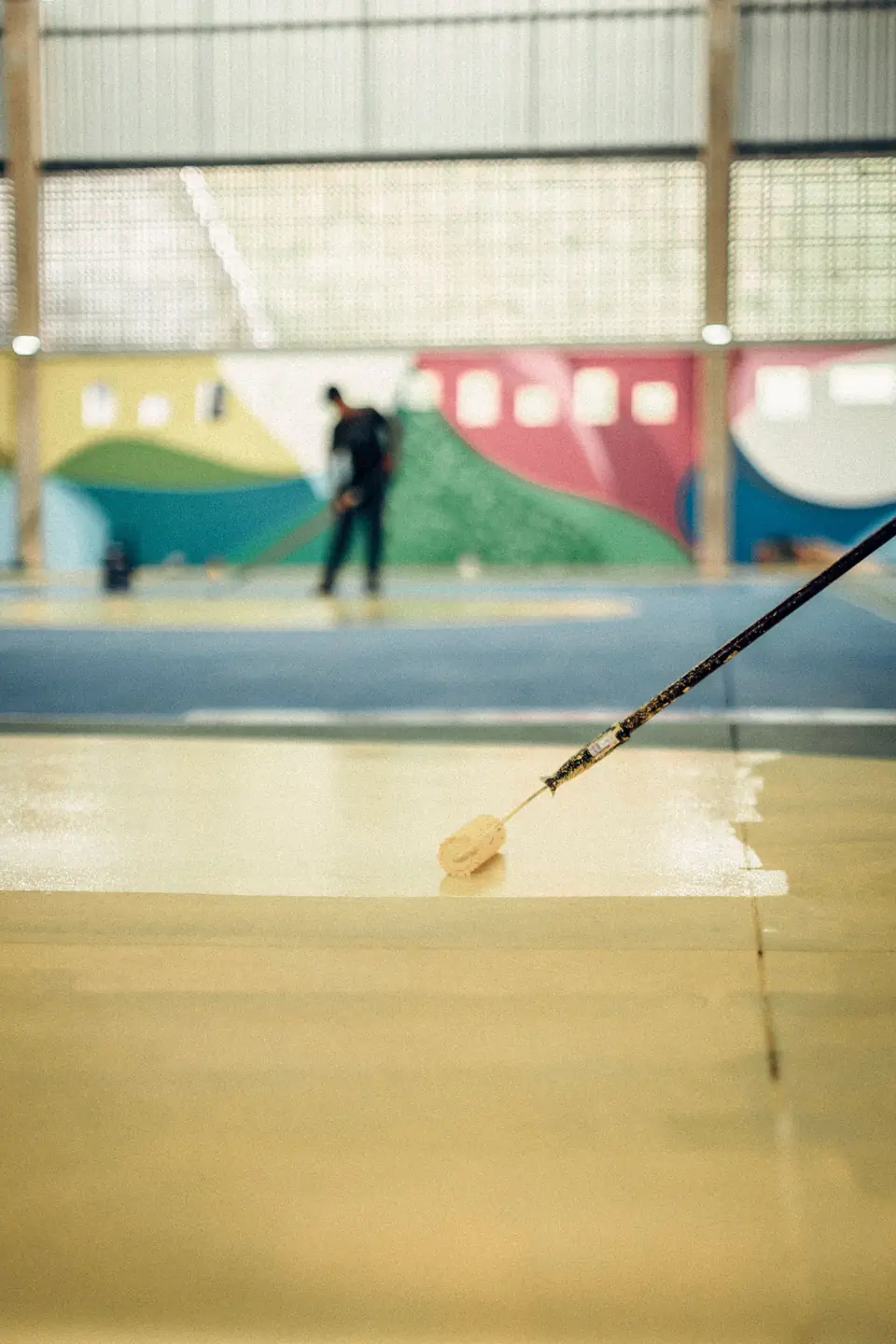
- ~4–6 h
- light traffic, APF Polyaspartic 7500 at 77°F
- ~2 days
- light traffic, Sikafloor-264 epoxy at 68°F
Polyaspartic is a two-component, aliphatic coating chemistry. In a typical garage system it is the clear wear layer on top: ground and primed concrete, a pigmented base, often a flake broadcast, then polyaspartic. Some products are made to be the whole system. Either way it is one layer choice inside an epoxy floor coating job, not a shortcut around the prep under it.
If you are still working out what your garage needs at all (salt at the door, joints, a spalled apron), start with our garage floor coating page. This one is about the chemistry choice: what the published cure times actually say, why the work window is short, what the labels mean, and when the faster product isn’t worth choosing.
- Faster to traffichours to walk on, a day or two to drive on, per the sheets below
- Shorter to workone maker says mix only what you can spread in 10 minutes
- Same slab rules50°F minimum, moisture limits, ground concrete
Polyaspartic Coating vs Epoxy: Walk-On, Drive-On and Recoat Times from the Data Sheets
Walking on a floor and parking on it are two different dates, and that gap is where the two chemistries differ most. These are the times five manufacturers publish for six products, each at the temperature printed on its own sheet. We cite them to show typical limits, not because we use a particular brand, and they are not our promises: a 55°F slab in a Cedar Rapids October cures slower than any row here.
Pick a milestone, then a product. The scale is logarithmic: an hour and a week both fit.
| Product, chemistry, temperature basis | Dry to touch | Foot traffic | Light traffic | Vehicle / heavy traffic | Recoat window | Full cure |
|---|---|---|---|---|---|---|
| Sikafloor-264 epoxy · 68°F | not stated | ~12 h | ~2 days | not stated | 8–24 h | ~7 days |
| Benjamin Moore HP4300 epoxy · 77°F, 50% RH | 6 h | not stated | 24 h (“light industrial service”) | 72 h (“moderate-to-heavy industrial service”) | 12–24 h | not stated |
| APF Epoxy 400 epoxy · 77°F | ~12 h | not stated | not stated | not stated | ~12–24 h | ~7 days |
| APF Polyaspartic 7500 Low Odor polyaspartic · 77°F | ~2–3 h | not stated | ~4–6 h | ~24 h | ~2–24 h | ~72 h |
| Duraamen Perdure P90 polyaspartic polyurea · 75°F | 2.5 h | not stated | 4–5 h | 48 h (“heavy traffic”) | 4 h (earliest) | not stated |
| Ameripolish Polyaspartic 85 polyaspartic · 75–77°F, 40–50% RH | 1–2 h | 2–4 h | 8–12 h (rolling equipment, wet cleaning) | 24–48 h | when tack-free | not stated |
- Sikafloor-264 (epoxy). Sika’s times are at 68°F. The same sheet stretches them at 50°F: foot traffic about 24 hours, light traffic about 3 days, full cure about 10 days, recoat 24 to 48 hours. Minimum 50°F for slab and air, slab at least 5°F above the dew point.
- Benjamin Moore HP4300 (epoxy). Times at 77°F and 50% relative humidity. The sheet says to abrade before recoating after 24 hours, and that the product “will amber and chalk” in UV light. Interior use only.
- APF Epoxy 400 (epoxy). Dry to touch about 12 hours and full cure about 7 days at 77°F, with a 20-minute pot life. The sheet gives no light-traffic time; APF sells a separate Fast Cure version with shorter times.
- APF Polyaspartic 7500 Low Odor. Two-component, aliphatic, 75% solids by volume. Vehicle traffic about 24 hours, full cure about 72 hours at 77°F. Apply between 50°F and 85°F, not above 80% humidity, and only over a primed surface. APF adds that lower temperatures and higher humidity lengthen cure time.
- Duraamen Perdure P90. Two-component polyaspartic polyurea, 90% solids by volume. Heavy traffic at 48 hours, recoat at 4 hours, substrate at least 50°F. Duraamen lists “Excellent hot tire pickup resistance” and, in the same sheet, “Very fast set (short working time).”
- Ameripolish Polyaspartic 85. Foot traffic 2 to 4 hours, vehicle loads 24 to 48 hours, and it “achieves high stain and hot tire resistance post-48 hours.” No full-cure time is stated; the sheet says thicker layers need longer before heavy use.
Every number above is the manufacturer’s, at the temperature in its row. A colder slab or more humid air pushes all of them later. Before work starts, we read the slab temperature and give you both dates in writing, adjusted for what we measure.
Sources: Sikafloor-264 PDS (Sept 2026) · Benjamin Moore HP4300 TDS · APF Epoxy 400 PDS · APF Polyaspartic 7500 PDS (07.18.25) · Duraamen Perdure P90 · Ameripolish Polyaspartic 85 TDS (Oct 2025)
Polyaspartic Epoxy? What the Name Actually Means
There is no such product as polyaspartic epoxy. People search for it because the two are sold together: an epoxy base with a polyaspartic topcoat. They are different chemistries that cure in different ways.
Polyaspartic esters were patented by Bayer in the early 1990s. They react with aliphatic isocyanates more slowly than the amines in pure polyurea, which reacts so fast it is “almost unusable without plural component spray equipment.” That slower reaction is what lets polyaspartic be mixed in a bucket and rolled. It is still fast, which is why every sheet on this page talks about working time.
On bids and kit boxes, the chemistry hides behind marketing words. Click a highlighted term on the sample sheet to see what it means and what to ask.
Chemistry background: Polyaspartic esters (Wikipedia, citing the Bayer and Miles patents). Product statements: APF 7500 · Duraamen P90 · Duraamen E12 · Ameripolish PA85 · Sika 264
Click a highlighted term
Product data sheetSample label, not a real product
[Product name] 2K Garage Topcoat
A two-component aliphatic polyaspartic polyurea for garage floors. 100% solids, low odor and UV stable. Self-priming for a true one-day floor. Stronger than polycuramine kits.
- Polyaspartic
A two-component coating built on polyaspartic esters and an aliphatic isocyanate hardener. APF calls its 7500 a “two-component, high-solids, aliphatic Polyaspartic”; Duraamen calls P90 a “polyaspartic aliphatic polyurea.” Products under the name differ a lot in solids, working time and what they may be applied over.
Ask: Which product is it, and can I see its technical data sheet?
- Polyurea
The wider family polyaspartic belongs to. Pure polyurea reacts so fast it is normally sprayed with plural-component equipment. A “polyurea” that goes down with a roller is a slowed-down type such as a polyaspartic, not the spray-grade product the word suggests.
Ask: Is it sprayed or rolled, and what’s the product name on the pail?
- Aliphatic
Describes the hardener side of the chemistry, and it is the reason for the non-yellowing claims. Aliphatic polyaspartics are sold as UV-stable. Standard epoxy is not: Sika’s 264 sheet says it “will discolor over time when exposed to sunlight (UV).”
Ask: Is the topcoat aliphatic, and what is the base coat under it?
- “100% solids”
How much of what is in the pail stays on the floor after it cures. Many polyaspartics are not 100%: APF lists 75% by volume for its 7500 and Duraamen 90% for P90. A Duraamen epoxy glaze, E12, is titled “100% solids” while its own data table lists 58% by volume, so read the table, not the headline.
Ask: What are the solids by volume, and how many wet mils per coat?
- “Low odor”
A comparison, not “no odor.” APF lists its 7500 Low Odor at under 50 g/L VOC; Ameripolish’s Polyaspartic 85 is solvent-based at 55.12 g/L; Duraamen lists 0 for P90. APF also says not to apply with “poor ventilation/limited air changes.”
Ask: How will the garage be ventilated during the work, and should the door into the house stay shut?
- “UV stable”
A claim about the coat itself, not what’s under it. Sika warns that a UV-resistant topcoat “may not prevent discoloration of underlying coatings.” A clear polyaspartic over an epoxy base keeps its own clarity; the epoxy below can still amber where sun reaches it.
Ask: What is under the clear coat, and will that layer amber?
- “Self-priming”
Some polyaspartics are made to go onto ground concrete without a primer: Duraamen calls P90 “self-priming.” Others forbid it: APF’s 7500 says “Use only on primed substrates. Do not apply directly to concrete.” Same chemistry family, opposite instructions.
Ask: Does this product allow direct-to-concrete application, and how will the slab be ground first?
- “One-day floor”
Means the crew finishes in a day, not that you park that evening. The sheets list vehicle traffic at about 24 hours (APF 7500), 24 to 48 hours (Ameripolish) and 48 hours to heavy traffic (Duraamen), each at 75–77°F. The day also assumes the grinding, crack repair and moisture readings all go to plan.
Ask: On which day can I drive in, at my slab’s temperature?
- Polycuramine
Rust-Oleum’s marketing name for the chemistry in its RockSolid coatings. It isn’t a category you will find on other makers’ sheets, and we could not get a Rust-Oleum technical data sheet to check its cure times, so we don’t quote any. If someone offers you a polycuramine garage floor coating, judge it the way you’d judge any other: by the data sheet, the film thickness and the prep.
Ask: Where is the technical data sheet with pot life, minimum temperature and film thickness?
Why a Polyaspartic Garage Floor Is Mixed and Rolled in Small Batches
Here is something the sales pitches skip: on paper, polyaspartic and epoxy pot lives overlap. Both sit roughly between 15 and 45 minutes at room temperature. The difference is what the polyaspartic sheets tell the crew to do with those minutes, and how fast the thin film sets once it is on the floor.
Polyaspartic topcoats go on thin, about 5 to 6 mils wet for APF’s 7500 and Duraamen’s P90 and 6 to 12 mils for Ameripolish’s 85, and they reach dry-to-touch in one to three hours where the epoxies above list six to twelve. So the limit isn’t only how long the bucket stays liquid. It’s how long the edge you rolled a few minutes ago stays wet enough to blend into.
The sheets are blunt about it. Ameripolish: “Limit mixing to quantities usable within 10 minutes,” viscosity “doubling in 10-15 minutes,” and finish “the process, including overlapping batches, in under 10 minutes.” APF: keep a “wet edge” and “do not attempt to roll over material that has begun to set.” Duraamen gives P90 a 15-minute working time at 70°F and warns it gets shorter in heat and humidity.
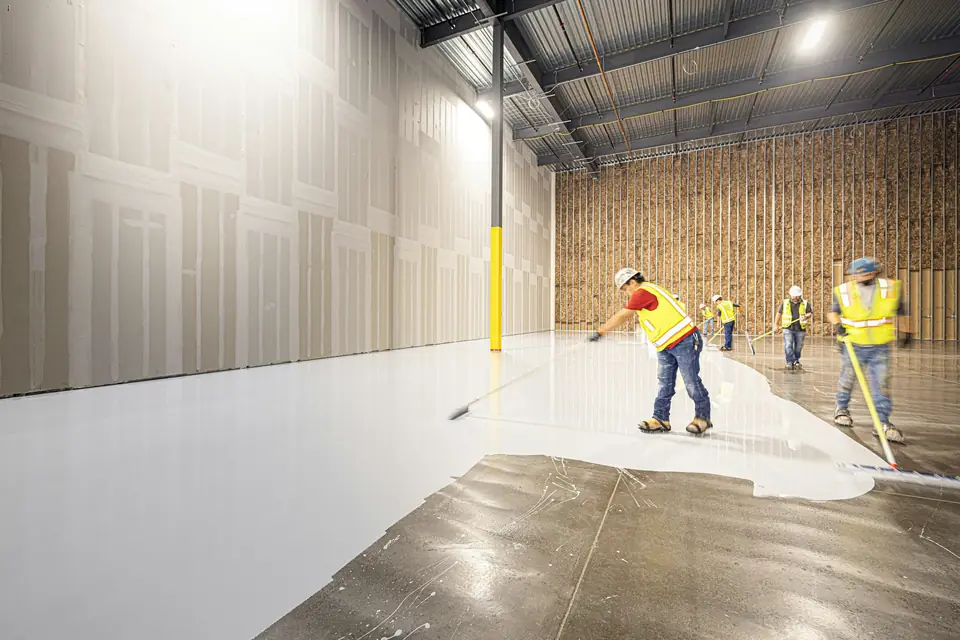
That is why a polyaspartic garage is a crew job. Batches are sized to the window, not to the pail. One person mixes with a drill, because APF says its material “cannot be properly mixed by hand.” Someone cuts in the stem walls and door edge just ahead of the rollers. The rollers keep a bead at the advancing edge and work each batch into the last one. Nobody stops halfway across the floor to answer the phone.
- Lap marks and seams. A new batch laid against an edge that has started to set leaves a visible line. Ameripolish’s fix is a generous bead along the advancing edge that each new batch merges into.
- Roller marks and drag. Rolling material that has thickened leaves ridges that cure in place. APF’s method is two full passes, north-south then east-west, while the material is still fresh.
- Bubbles, voids and haze. Whipping air in while mixing causes bubbles. Going too thick does too: APF says over 10 mils its 7500 makes excess CO2 and surface defects; Ameripolish says over 15 mils causes micro-voids and cloudiness.
Ameripolish Polyaspartic 85 TDS · APF Polyaspartic 7500 PDS · Duraamen Perdure P90 · Sikafloor-264 PDS · Benjamin Moore HP4300 · APF Epoxy 400
Pick a product, then run the batch
- Sikafloor-264 epoxy at 50°F: about 50 minutes of pot life. Cold buys working time and costs cure time.
- Sikafloor-264 epoxy at 68°F: about 25 minutes.
- Sikafloor-264 epoxy at 86°F: about 15 minutes. Heat shortens every window on this list.
- Benjamin Moore HP4300 epoxy at 77°F: 30 minutes.
- APF Epoxy 400 at 77°F: 20 minutes (ASTM D2471).
- APF Polyaspartic 7500 at 77°F: about 20 to 30 minutes of pot life and working time. APF adds that work life is “considerably shortened over 90°F.”
- Duraamen Perdure P90: 15 minutes of working time at 70°F and 50% RH, 20 minutes of pot life. Don’t mix below the dew point, which also shortens it.
- Ameripolish Polyaspartic 85: the sheet lists a 30 to 45 minute pot life, but says to mix only what can be used within 10 minutes at 50% RH, because viscosity doubles in 10 to 15 minutes.
- Inside the window. The material levels and blends into the wet edge.
- At the edge. It’s thickening. Finish this batch and merge it into the bead; don’t start a new pass over it.
- Past the published window. Rolling now leaves lap lines, roller ridges or trapped bubbles. What’s left in the bucket gets thrown out, not stretched.
Published figures at the temperature shown. The clock is a teaching aid; it says nothing about how fast any crew rolls.
Will a Polyaspartic Floor Coating Yellow in the Sun?
Not according to the people who make it. All three polyaspartic sheets on this page claim UV stability: APF’s 7500 is “UV stable to ensure long-term gloss retention and resistance to yellowing,” Duraamen says P90 “does not turn ‘yellow’ or ‘amber’,” and Ameripolish lists “UV stability (non-yellowing).” The epoxy sheets say the opposite about themselves. That difference is the strongest reason to put polyaspartic on top.
The catch is what sits under the clear coat. Sika says a UV-resistant topcoat “may not prevent discoloration of underlying coatings,” so an epoxy base in a sunny spot can still warm in color under a perfectly clear polyaspartic. The same chemistry logic is why metallic systems are finished with a clear aliphatic coat: Walt Tools tops its metallic pours with an aliphatic urethane or Polyaspartic 85 and calls both “clear and non-yellowing.”
| Product | What its sheet says about UV |
|---|---|
| Sikafloor-264 (epoxy) | “Will discolor over time when exposed to sunlight (UV) and under certain artificial lighting conditions.” |
| Benjamin Moore HP4300 (epoxy) | “This product will amber and chalk if exposed to ultraviolet light.” |
| APF Polyaspartic 7500 | “UV stable to ensure long-term gloss retention and resistance to yellowing.” |
| Duraamen Perdure P90 | “UV resistance, does not turn ‘yellow’ or ‘amber’.” |
| Ameripolish Polyaspartic 85 | “UV stability (non-yellowing).” |
Sika · Benjamin Moore · APF · Duraamen · Ameripolish · Walt Tools metallic system
Where does light reach your floor?
- A south- or west-facing door that stays up on summer afternoons
Sun lands on the same strip of floor for hours. Both epoxy sheets say they will discolor or amber, so epoxy should not be the top layer here. An aliphatic polyaspartic topcoat is what the sheets support, ideally over a base that won’t show a warm cast, such as a full flake broadcast.
- A basement with window wells, a walkout door or bright fixtures
Light is patchy, which can mean patchy color change in an epoxy near the glass. Sika also names “certain artificial lighting conditions.” A clear aliphatic topcoat is a reasonable call over a light or decorative base, where a color shift would show.
- A garage where the door stays down and the floor never sees the sun
UV stability buys little here. Pick the topcoat for tires, salt, chemicals and how fast you need the garage back, not for yellowing.
The tiles illustrate the data-sheet statements; they are not a measured color change.
Garage Polyaspartic on the Cedar Rapids Calendar: Shoulder Seasons and the 50°F Limit
Fast cure matters most in the shoulder months, when a Cedar Rapids install is racing the next cold snap. In October the average high at the airport is 61.5°F and the low 39.9°F. A topcoat that APF times at about 24 hours to vehicle traffic (at 77°F) can have the car back inside before the weather turns, while an epoxy coat Sika times at about 2 days to light traffic at 68°F, and about 3 days at 50°F, keeps it in the driveway through more of that weather.
The cold limit doesn’t move, though. APF and Duraamen both print a 50°F minimum for their polyaspartics, the same floor Sika and Benjamin Moore set for epoxy. In March and November the average high is about 46°F, and the slab in an unheated garage runs colder than the afternoon air. A fast-curing product doesn’t make a cold slab warm. It only cures faster once the slab is warm enough.
- A heated, attached garage can work through winter if it holds the slab at 50°F or above, at least 5°F over the dew point, before, during and after the coat.
- Don’t fix a cold garage with a salamander heater. APF says kerosene or propane forced-air heating during application “may cause discoloration and finish defects”; Sika warns unvented heaters can cause blushing in epoxy.
- Humidity counts too: APF says not to apply its 7500 above 80% humidity, and Ameripolish calls air below 60% ideal for working time.
For a detached, unheated garage, we would rather book you for late April or May than coat a slab that can’t meet the sheet.
| Month | Avg high | Avg low | Nights ≤32°F | Low to high, 0–80°F |
|---|---|---|---|---|
| Sep | 74.7°F | 51.9°F | 0.3 | |
| Oct | 61.5°F | 39.9°F | 7.3 | |
| Nov | 46.2°F | 27.7°F | 20.8 | |
| Dec | 33.3°F | 17.1°F | 28.5 | |
| Jan | 27.9°F | 11.3°F | 30.0 | |
| Feb | 32.6°F | 15.5°F | 26.1 | |
| Mar | 46.3°F | 26.8°F | 22.6 | |
| Apr | 60.1°F | 37.6°F | 8.1 | |
| May | 71.1°F | 49.5°F | 0.4 |
Air temperatures at the airport, not slab temperatures in your garage: NOAA Summary of Monthly Normals, Cedar Rapids Muni AP (USW00014990). Over a full year the airport averages 144 nights at or below freezing. Product limits: APF 7500 · Duraamen P90 · Ameripolish PA85 · Sika 264
Where Polyaspartic Flooring Is Worth It, and Where It Isn’t
Polyaspartic is the better topcoat in some rooms and an upgrade nobody will notice in others. Here is how we would sort it, including the cases where we would steer you to something simpler.
Where polyaspartic usually earns its place
- An attached garage you park in every day, especially in a fall or spring install, where getting the car back inside in a day or two matters more than a few extra days of epoxy cure.
- A garage that gets sun. A door facing south or west, open on summer afternoons, is exactly where the epoxy sheets warn about ambering.
- Clear coats over color. Over flake or a metallic base, yellowing shows; aliphatic clarity is the point.
- Hot tires. Duraamen claims “excellent hot tire pickup resistance” for P90, and Ameripolish claims hot-tire resistance after 48 hours for its 85. That only holds over a well-bonded system.
- Floors that must reopen fast. APF lists automotive, food service and healthcare among its 7500 uses. For shop and warehouse floors, the chemicals and the shutdown schedule set the spec.
Where a polyaspartic topcoat often adds little
- A basement that never sees sun or tires. There is no UV to fight and nobody waiting to park, so a polyaspartic layer on top of an epoxy system may be paying for properties the room doesn’t need. If you only want the concrete protected, a penetrating sealer may be enough.
- An unheated garage between November and March. The 50°F minimum applies to both chemistries. Wait for spring.
- One thin coat over a poorly prepped slab. A single polyaspartic coat on unground or damp concrete fails as fast as anything else. Fast cure shortens the job, not the prep.
- A shop with regular brake-fluid or solvent spills. Duraamen rates P90 only “limited” (occasional spills) for brake fluid, acetone and MEK. Check the chemical chart against what actually hits the floor.
- A crew short on hands. If the bid has one person mixing and rolling a three-car garage alone, ask how they will keep a wet edge.
| Build | What the sheets support | Good fit for |
|---|---|---|
| Clear polyaspartic over an epoxy base with a full flake broadcast | APF calls its 7500 “ideally suited for use as a finish coat in decorative flake and color quartz flooring systems.” | Most daily-use garages; see our flake broadcast systems for blends and chip size. |
| A polyaspartic flake floor: primer, pigmented polyaspartic base, flake, clear polyaspartic top | APF sells pigment packs in nine standard colors for its 7500, which still goes over a primed surface. | Owners who want the fastest return to service and accept the tightest working window on every coat. |
| One or two clear coats over ground concrete | Only with a product rated for it, such as Duraamen’s self-priming P90, at 5 to 6 mils. | A tough, non-yellowing seal that still looks like concrete. It hides nothing. |
| Clear aliphatic topcoat over a metallic pour | Walt Tools finishes metallic floors with an aliphatic urethane or Polyaspartic 85, both “clear and non-yellowing.” | Decorative basements and showrooms where any color shift would show. |
APF 7500 · Duraamen P90 (chemical resistance chart) · Ameripolish PA85 · Walt Tools metallic system
Ask About a Polyaspartic Garage Floor Coating for Your Slab
If you searched for polyaspartic garage floor coating near me and landed here, tell us three things: which way the garage door faces, whether the garage is heated, and when you need to park in it again. Those answers plus photos of the slab tell us whether polyaspartic is the right topcoat for you or just the faster one.
- We reply by phone or email. If the floor needs a moisture test or a look in person before anyone can name a system, we say so instead of guessing.
- No price comes back until someone has seen the slab, in person or in good photos.
- If you're outside the area we cover, we'll tell you and point you toward someone closer.
Rather talk? (319) 302-3992 · info@cedarrapidsepoxypros.com
Polyaspartic Garage Floor Coating Questions to Settle Before You Book
Can polyaspartic go straight onto bare concrete?
Some products can and some can’t, so the data sheet decides. Duraamen describes its Perdure P90 as “self-priming” over properly prepared concrete. APF’s 7500 says the opposite: “Use only on primed substrates. Do not apply directly to concrete.” Either way, bare means diamond ground, not swept. Cracks get filled first, and the moisture reading has to be under the product’s limit. Ameripolish lists 3 lb by calcium chloride for its Polyaspartic 85, and Duraamen says to avoid slabs with active moisture vapor transmission. Duraamen P90 · APF 7500
Is a polyaspartic floor really a one-day job?
The application can be. The drive-on date usually isn’t. At the temperatures printed on their sheets, APF lists vehicle traffic at about 24 hours for its 7500, Ameripolish lists 24 to 48 hours for its Polyaspartic 85, and Duraamen lists 48 hours to heavy traffic for P90. Grinding, crack repair and any moisture primer come before any of that, and a cold slab adds time. Ask for a walk-on date and a drive-on date, not just the hour the crew leaves.
Can polyaspartic go over the epoxy I already have?
Only over a coating that is still bonded everywhere. A clear coat glued to a lifting layer comes up with it, so loose areas come off first (see peeling and hot-tire lift repairs). A sound old coating is cleaned and abraded so the new coat has something to grip. APF’s own instructions for recoating its 7500 after 24 hours call for 100-grit abrasion to a uniform, gloss-free surface. A clear topcoat won’t undo amber that is already in the old epoxy, and Sika notes a UV-resistant topcoat “may not prevent discoloration of underlying coatings.”
Does a polyaspartic floor get slippery when it’s wet?
A clear, high-gloss coat over a smooth base can be slick under wet slush. APF lists a 60° gloss of 95 for its 7500. Grip is decided before the topcoat goes on: a full flake broadcast underneath gives the surface some tooth, or an anti-slip additive goes into the topcoat. Ameripolish lists “anti-skid finishes (when additives are incorporated)” among the systems its Polyaspartic 85 can top. More texture means more grip and a floor that takes a little more effort to mop.
Can a polyaspartic garage floor go down in November?
In a heated, attached garage that holds the slab at 50°F or warmer through the cure, possibly. In an unheated garage, usually not. NOAA’s 1991–2020 normals put the average November high at the Cedar Rapids airport at 46.2°F, below the 50°F minimum APF and Duraamen print, and a slab runs colder than the afternoon air. Warming a cold garage with a kerosene or propane forced-air heater causes its own trouble: APF warns those heaters “may cause discoloration and finish defects.” If the numbers don’t work, the honest answer is late April or May. NOAA normals for CID